Launch Your Own Skincare Brand
Global Leading laboratory for Custom formulation and Contract Manufacturing beauty products.

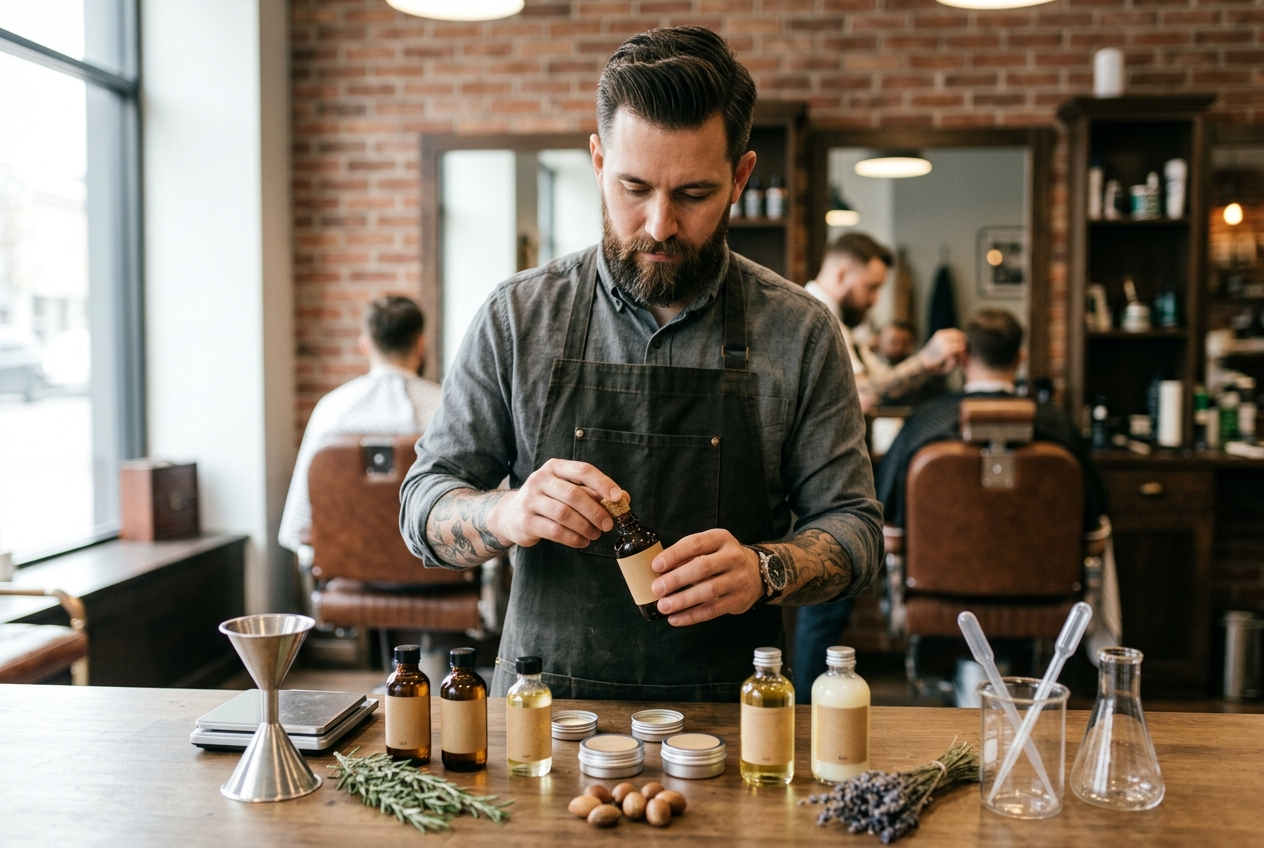
The 2026 Men’s Grooming Landscape: Why Barbershop Brands are Essential
A barbershop owner in Austin recently told me something that stuck: “I spent ten years perfecting my craft behind the chair, and my clients kept asking me what products I use at home. I realized I was leaving money on the table every single day.” That conversation captures exactly why so many barbers and shop owners are now creating their own product lines in 2026. The shift isn’t hypothetical or aspirational – it’s already happening at scale.
The US barbershop industry generated $7 billion in revenue in 2025, and the global men’s grooming market is on track to hit $108 billion by 2035. Those numbers represent real demand from real men who are spending more on their appearance than any previous generation. If you own a barbershop or are thinking about launching a grooming brand, 2026 is the year to stop thinking about it and start doing it.
Starting a barbershop brand and building your own product line isn’t just about slapping your logo on a pomade jar. It requires understanding your customers, choosing the right manufacturing path, nailing your brand identity, and building distribution channels that actually move units. This guide walks through every stage of that process with specific numbers, real comparisons, and practical steps you can act on this quarter.
The Shift from Service-Based to Product-Based Revenue
Most barbershops run on a simple model: charge per haircut, fade, or beard trim, pay your barbers, cover rent, and hope the margins work out. The problem is that service-based revenue has a hard ceiling. You can only fit so many chairs in a shop, and your barbers can only work so many hours. Product sales blow that ceiling off entirely.
Retail product sales contribute 10-15% of a barbershop’s total revenue on average, but the most profitable shops push that number to 25-30%. The difference between a shop making 12% from retail and one making 28% often comes down to one thing: whether they’re selling generic brands or their own label. When a client buys a third-party pomade from your shelf, you might make a 40-50% margin. When they buy your house brand, that margin jumps to 350-450% on cost.
The math is straightforward. A private label pomade that costs you $3-5 per unit to manufacture can retail for $18-24 under your own brand. Multiply that across your client base, add in online sales, and you’re looking at a revenue stream that doesn’t require anyone to sit in a chair.
Consumer Expectations for Professional-Grade Home Care
Men’s grooming habits have changed dramatically. The guy who used to grab whatever shampoo was cheapest at the drugstore now watches YouTube tutorials on how to style a textured crop. He follows barbers on Instagram. He wants to recreate the look he gets in the shop, and he’s willing to pay for products that help him do it.
This shift in consumer behavior is your opportunity. Your clients already trust your hands and your expertise. They see you as an authority on what works for their hair type, their skin, their beard. When you hand them a product with your brand on it and say “this is what I used on you today,” that recommendation carries enormous weight. No influencer ad or Amazon listing can replicate the trust built during a 45-minute haircut.
The men’s grooming products market is projected to grow at a CAGR of 5.8% through 2035, and professional-grade home care products are driving a significant portion of that growth. Men don’t just want products – they want products that feel like they belong in a barbershop, not a pharmacy aisle.
Defining Your Brand Identity and Target Demographic
Before you pick a single ingredient or design a label, you need to answer a question that most new brand owners skip: who exactly is this for? “Men who care about their hair” is not a target demographic. It’s a vague gesture at half the population.
Get specific. Are you targeting young professionals aged 25-35 who want a clean, minimal aesthetic? Or are you going after the classic barbershop crowd that gravitates toward vintage Americana vibes? Maybe your clientele skews toward men of color who need products formulated for coarser, curlier hair textures. Each of these audiences has different product needs, different price sensitivities, and different visual preferences.
Your brand identity should flow directly from your shop’s existing identity. If your barbershop has exposed brick, leather chairs, and a whiskey bar, your product line should feel like an extension of that experience. If your shop is modern and minimalist with clean lines, your packaging should match. Consistency between the in-shop experience and the product shelf is what makes a barbershop brand feel authentic rather than like a cash grab.
Identifying Your Signature Barbershop Aesthetic
Think about what makes your shop different from the one three blocks away. Maybe it’s your specialty in razor fades. Maybe it’s the fact that you use only natural, plant-based products. Maybe it’s the vibe – the music, the conversation, the community you’ve built. Your product line needs to bottle that identity, literally and figuratively.
Scent is one of the most powerful tools you have here. Fragrance families like cedarwood and sandalwood evoke classic masculinity. Citrus and eucalyptus blends feel fresh and modern. Herbal combinations with tea tree or peppermint signal a natural, health-conscious approach. The scent profile of your products should be something clients associate with the experience of being in your chair.
Packaging materials matter just as much. A matte black tin with embossed lettering positions your brand at a premium price point and looks great on a bathroom shelf. Clear plastic jars with simple labels feel more approachable and work well at lower price points. Glass containers add perceived luxury but increase shipping weight and breakage risk – something to factor in if you plan to sell online.
Your brand name, logo, color palette, and typography should all tell the same story. Hire a designer who understands the barbershop world, not just someone who makes pretty logos. The visual identity needs to hold up on a 2-inch jar label, a website header, and an Instagram grid simultaneously.
Private Label vs Custom Formulation for Men’s Grooming
This is where most new brand owners get stuck, and honestly, it’s where the biggest decisions happen. The choice between private label and custom formulation affects your timeline, your budget, your margins, and how differentiated your products actually are. Neither option is universally better – the right choice depends on where you are in your business journey.
Speed to Market with Private Label Hair Styling Products
Private label means choosing from a manufacturer’s existing catalog of proven formulations, then applying your own branding, packaging, and labeling. The product inside the jar is the same formula the manufacturer has already developed, tested, and produced for other brands – but the outside is entirely yours.
The biggest advantage of private label hair styling products for professional barbers is speed. You can go from concept to finished product in 4-8 weeks, compared to 4-6 months for a fully custom formulation. If you want to test the market with a small initial run, private label lets you do that without betting the farm.
Minimum order quantities tend to be lower with private label as well. Manufacturers like Awilke Branding offer MOQs as low as 100-500 units for private label products, which means your initial investment might be $500-2,000 depending on the product type and packaging choices. That’s manageable for most established barbershop owners.
The product range available through private label is broader than most people expect. You can typically choose from pomades in various hold levels (light, medium, firm), clay-based styling products with matte finishes, sea salt sprays, beard oils, beard balms, shampoos, conditioners, and aftershave balms. Each comes with an established INCI list that’s already been tested for stability and safety.
Building Unique IP through Custom Formulation
Custom formulation – sometimes called ODM (Original Design Manufacturing) – is a different animal entirely. Here, you work with a formulation chemist to develop a product from scratch based on your exact specifications. You choose the base (water-based vs. oil-based), the hold level, the shine finish (matte to high gloss), the texture (creamy, waxy, clay-like), and every active ingredient.
This path makes sense when you have a specific product vision that doesn’t exist in any catalog. Maybe you want a pomade that combines the hold of a clay with the finish of a cream, or a beard oil that incorporates a proprietary blend of argan, jojoba, and black seed oils. Custom formulation gives you intellectual property that competitors can’t easily replicate.
The tradeoff is time and money. Expect 3-6 rounds of sample revisions before you land on a formula you’re happy with. Each round takes 2-4 weeks. The MOQs for custom formulations are often higher – sometimes 1,000-3,000 units or more per SKU.
Cost-Benefit Analysis for New Brand Owners
Here’s my honest recommendation: if this is your first product line, start with private label. Launch two or three core SKUs – a styling product, a shampoo, and a beard oil is a solid starter kit. Test them with your existing clientele. Gather feedback. See what sells and what sits on the shelf.
Once you have market validation and cash flow from your initial products, invest in custom formulations for your hero products. This staged approach lets you build a brand without risking $30,000-50,000 on untested custom formulas. The decision between private label vs custom formulation for men’s grooming isn’t binary – most successful barbershop brands use both approaches strategically across their product lines.
A quick comparison to keep in mind:
- Private label timeline: 2-6 weeks
- Custom formulation timeline: 3-6 months
- Private label MOQ: 100-500 units
- Custom formulation MOQ: 1,000-3,000+ units
Sourcing and Manufacturing Private Label Products for Professional Barbers
Finding the right manufacturer is arguably the most consequential decision you’ll make in this process. A bad manufacturing partner can sink your brand before it launches – through quality inconsistencies, missed deadlines, or compliance failures that get your products pulled from shelves.
Evaluating Ingredients and Sustainable Packaging Trends
Ingredient quality directly affects product performance, and your barber clients will notice the difference immediately. A cheap pomade with heavy petroleum-based ingredients will feel greasy and leave residue. A well-formulated water-based pomade with beeswax, lanolin, and natural oils will perform better and wash out cleanly.
Look for manufacturers that provide full INCI lists and certificates of analysis (COAs) for raw materials. Ask about ingredient sourcing – are they using cosmetic-grade shea butter, or the cheapest alternative they can find? The difference in raw material cost per unit might be $0.50-1.00, but the difference in product performance is massive.
Sustainable packaging is no longer optional if you want to appeal to consumers under 40. Post-consumer recycled (PCR) plastics, aluminum tins, and glass containers with bamboo caps are all trending in 2026. Refillable containers are gaining traction too, especially for shampoos and conditioners. Your manufacturer should be able to source these options without dramatically increasing your per-unit cost.
Consider the full packaging ecosystem: the primary container, the label or printing, the secondary packaging (boxes, inserts), and the shipping materials. Each touchpoint is a branding opportunity. A well-designed unboxing experience for e-commerce orders can generate organic social media content when customers share it.
Vetting Manufacturers for Quality and Compliance
Not all manufacturers are created equal, and the vetting process matters enormously. Start with certifications. At minimum, your manufacturer should hold GMP (Good Manufacturing Practice) certification. ISO 22716 certification is the international standard specifically for cosmetics manufacturing, and it signals that the facility follows documented quality management processes from raw material intake through finished product release.
Awilke Branding, for example, holds both GMP and ISO 22716 certifications and specializes in men’s grooming products with low MOQs – which makes them worth considering if you’re a barbershop owner launching your first line without the volume to meet the 10,000-unit minimums that many domestic manufacturers require.
Compliance is the other critical piece. If you’re selling in the US, your products need to meet FDA cosmetic labeling requirements. If you plan to sell in the EU, you’ll need a Product Information File (PIF) and compliance with EU Regulation 1223/2009. Your manufacturer should either handle this for you or provide the documentation you need to handle it yourself. Don’t skip this step – regulatory violations can result in product recalls and fines that will bury a small brand.
Strategic Marketing and Omnichannel Distribution
You’ve got your products manufactured, your branding dialed in, and boxes arriving at your shop. Now what? The best product in the world won’t sell itself, and the marketing strategy for a barbershop brand is fundamentally different from a typical DTC beauty brand.
Leveraging In-Chair Recommendations for Initial Sales
Your barber chair is the most powerful sales tool you’ll ever have. Every client interaction is a 30-60 minute product demonstration. You’re literally applying your products to their hair, showing them the results in real time, and explaining how to recreate the look at home. No paid ad can compete with that level of trust and engagement.
Train every barber in your shop on each product’s features, benefits, and ideal use case. They should know which pomade works best for thick, coarse hair versus fine, straight hair. They should be able to explain the difference between your matte clay and your medium-hold cream without reading the label. Product knowledge turns your team into brand ambassadors.
Create a simple recommendation system. After every cut, the barber mentions the products they used and offers the client a chance to purchase. No hard sell – just a natural extension of the service. “I used our house pomade on you today. It’s a medium hold with a natural finish, and it washes out easily. Want to grab one on your way out?” That’s it. Simple, genuine, effective.
Shops that implement loyalty programs see a 20% increase in customer retention, and you can tie product purchases into your loyalty structure. Buy five haircuts, get a free travel-size product. Purchase three products, earn a discount on your next cut. These programs create a flywheel where service visits drive product sales and product sales drive return visits.
Scaling via E-commerce and Social Media in 2026
Your shop’s four walls limit your service revenue, but they don’t have to limit your product revenue. E-commerce opens your brand to customers who will never walk through your door but who connect with your brand story online.
Start with a simple Shopify store. You don’t need 47 pages and a blog on day one. You need clean product photos, clear descriptions that specify hold level, shine finish, key ingredients, and hair type compatibility, plus a straightforward checkout process. Add a subscription option for consumables like shampoo and beard oil – recurring revenue is the holy grail of e-commerce.
Social media in 2026 is still dominated by short-form video, and barbershops have a natural advantage here. Transformation videos (before and after a cut), product application tutorials, and behind-the-scenes content consistently perform well. Show the product being used in a real haircut, not just sitting on a shelf. Tag the products in your posts and link to your shop.
Industry experts have noted that “barbershops today must evolve beyond haircuts” and that incorporating grooming services and social media are essential to staying competitive in 2026. Your product line gives you something to post about beyond just haircuts – product launches, ingredient spotlights, styling tips, and customer testimonials all create content variety that keeps your audience engaged.
Consider listing on Amazon as well, but approach it strategically. Amazon gives you access to massive traffic, but the platform takes a significant cut (typically 15% referral fee plus FBA fees) and you lose control over the customer relationship. Many barbershop brands use Amazon as a discovery channel while pushing repeat customers toward their own website where margins are higher.
Future-Proofing Your Brand for Long-Term Growth
Building a product line that lasts requires thinking beyond your first three SKUs. The barbershop brands that thrive over the next decade will be the ones that treat their product line as a living, evolving business – not a side project.
Start by collecting data from day one. Track which products sell fastest, which get reordered most, and which generate the most positive feedback. Use this data to inform your product development roadmap. If your medium-hold pomade outsells everything else 3-to-1, that tells you something about your customer base. Maybe your next product should be a medium-hold clay or a pre-styler that pairs with it.
Expand your product range methodically. A solid growth trajectory might look like this: launch with 3 SKUs in year one, add 2-3 more in year two based on customer feedback, and introduce a premium or specialty line in year three. Don’t try to be a full catalog brand overnight – that’s how you end up with dead inventory and cash flow problems.
The barbershop industry is growing at a steady 1.7% annual rate, which might sound modest until you realize that’s consistent, reliable growth in a market that’s already massive. Your product brand can grow faster than the industry average because you’re capturing revenue from a new channel, not just competing for existing service dollars.
Think about wholesale and B2B distribution as your brand matures. Other barbershops might want to carry your products. Boutique men’s retailers, hotel gift shops, and subscription box services are all potential channels. Each new distribution point increases brand visibility and creates revenue that doesn’t depend on your own shop’s foot traffic.
Protect your brand legally. Trademark your brand name and logo. If you’ve developed custom formulations, ensure your manufacturing agreements specify that you own the formula IP. These steps cost a few hundred to a few thousand dollars but can save you from devastating problems down the road.
The barbershop owners who will win in 2026 and beyond are the ones who see themselves not just as service providers, but as brand builders. Your product line is an extension of your expertise, your reputation, and the trust you’ve built with every client who’s sat in your chair. Treat it with that level of seriousness, and the returns will follow.
If you’re ready to move from concept to actual production, working with a certified manufacturer who understands the men’s grooming space makes the process dramatically smoother. Awilke Branding offers GMP-certified manufacturing, custom formulations, and low MOQs specifically designed for emerging brands – get in touch to request a free sample or quote and see how your product vision can become a reality.
Frequently Asked Questions
What is the minimum order quantity (MOQ) for launching a barbershop product line? MOQs vary by manufacturer and product type. Specialist manufacturers like Awilke Branding offer minimums from as low as 100-500 units, specifically designed for barbershop owners testing the market for the first time. Larger factories typically require 3,000-5,000 units per SKU, which suits established brands but creates a significant barrier for first-time launchers. Starting with a low MOQ lets you validate which products your clients actually buy before committing to a larger production run. Budget $5,000-$15,000 for an initial run of 2-3 products including packaging and labelling.
Do I need any special licences to sell grooming products under my own brand? In the US, grooming and styling products are regulated as cosmetics by the FDA – no pre-market approval is required, but products must comply with FDA labelling rules including INCI ingredient names, net weight, and distributor information. You’ll need a standard business licence and, depending on your state, a seller’s permit. If you plan to sell in the EU, requirements are considerably stricter: you’ll need a Responsible Person, a Product Information File (PIF), and CPNP portal registration before selling a single unit. A reputable manufacturer will supply the Certificate of Analysis and safety documentation you need for your target market – always confirm this before signing a production agreement.
How long does it take to go from idea to finished product on shelves? For private label products using an existing stock formula, the realistic timeline from first manufacturer contact to finished goods in your shop is 8-12 weeks. This breaks down as: sample selection and approval (1-2 weeks), label and packaging design (2-3 weeks), production run (3-4 weeks), and shipping (2-3 weeks for overseas manufacturing). Custom formulations – where the manufacturer develops a unique recipe to your brief – add 2-4 months to the front end for development, sampling, and stability testing. Build in buffer time if you’re targeting a specific launch date or seasonal campaign.
What are the most profitable product categories for barbershop brands? Styling products consistently deliver the highest margins in the men’s grooming category. A pomade or matte clay that costs $1-3 to manufacture can retail for $18-24 under your own brand – a 350-450% markup on cost. Beard oils and balms are similarly high-margin and have strong repeat purchase rates since clients run through them quickly. Shampoos and conditioners carry lower per-unit margins but higher consumption frequency, making them well suited to subscription models that generate predictable recurring revenue. For a first launch, a pomade or clay as your hero product paired with a beard oil covers the highest-value, highest-repeat segment of the men’s grooming market.