
Launch Your Own Skincare Brand
Global Leading laboratory for Custom formulation and Contract Manufacturing beauty products.

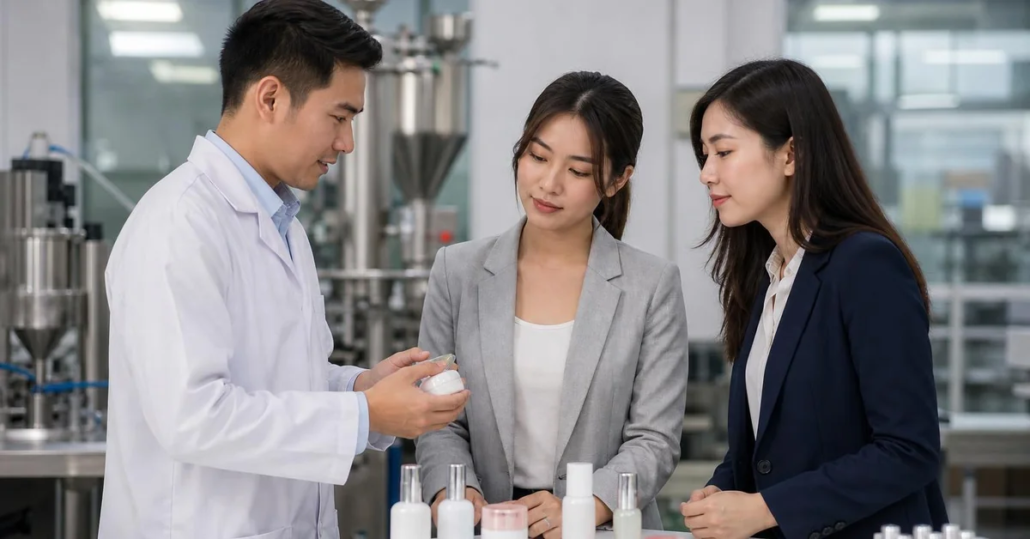
Every beauty brand starts with a choice that shapes everything from profit margins to product uniqueness: do you build a formula from scratch, or put your label on something that already works? The question of OEM vs ODM cosmetics is one that founders, Amazon sellers, and spa owners wrestle with constantly, and the answer isn’t the same for everyone. With the global cosmetics OEM/ODM market valued at $77.4 billion in 2026, the manufacturing infrastructure available to independent brands has never been stronger. But picking the wrong model can burn through your budget, delay your launch by months, or leave you selling a product that’s indistinguishable from ten other brands on the shelf. Here’s how to figure out which path actually fits your situation.
Defining OEM and ODM the Right Way
These two acronyms get tossed around loosely, and sometimes interchangeably, which causes real confusion. They describe fundamentally different relationships between your brand and the factory making your products. Understanding the distinction clearly is the first step toward a smart manufacturing decision. At Awilke Branding, the distinction comes down to one thing: where the formula originates.
OEM (Original Equipment Manufacturing): You Bring the Formula
In an OEM arrangement, your brand provides the formula, product concept, or detailed requirements, while the manufacturer produces according to your specifications. Brands typically need to provide key information such as the formula, manufacturing process, approved raw material suppliers, and relevant stability or safety documentation. The formula remains your brand’s property, while the manufacturer handles production, sourcing, filling, and quality control. This model is ideal when you already know what you want to sell and need a reliable factory to manufacture it.
ODM (Original Design Manufacturing): The Manufacturer Develops It for You
ODM flips the starting point. Instead of you supplying the formula, the manufacturer’s in-house R&D team handles the complete product development process on your behalf, starting from a concept, a target ingredient profile, or even just a category and price point you want to compete in. The manufacturer formulates, tests, and refines the product around your specific requirements and brand vision. Once the formula is finalized, ownership and copyright of that formula remain with the manufacturer, since it was developed and refined using the manufacturer’s own R&D expertise and formulation library. What you get is a product tailored closely to your brief and positioning, even though the underlying formula itself is Awilke’s intellectual property rather than your brand’s. This is the model to choose when you have a product idea and a market position in mind, but not the in-house formulation expertise or R&D resources to build the formula yourself.
The key difference between the two models is who ends up owning the formula. With OEM, you own it because you supplied it or directed its creation. With ODM, Awilke owns it because Awilke’s team developed it. That said, neither model is a rigid, take-it-or-leave-it process: both OEM and ODM projects are customized around your product requirements, ingredient preferences, and brand vision. Ownership and customization are separate questions, and it’s worth being clear on both before you start a project.
The Case for OEM: When You Already Have the Formula
OEM is the right fit for brands that already know exactly what they want to sell, whether that formula came from your own chemist, a previous manufacturing relationship, or in-depth product testing you’ve already done.
You Retain Full Control Over the Specification
Because you’re supplying the formula or the detailed requirements, you control every input: active ingredient concentrations, exclusions, texture, and scent. The manufacturer’s job is to match that specification consistently, batch after batch. For brands that have invested time in developing a formula they believe in, OEM protects that investment and ensures the finished product reflects exactly what was intended.
What to Expect from the Manufacturer
A good OEM cosmetics manufacturer will confirm feasibility of your formula at their facility, run compatibility and stability testing, and produce samples for your approval before committing to a full production run. Manufacturers with lower minimum order quantities make OEM production far more accessible to smaller and newer brands, since you’re not required to commit to a large volume just to get your own formula into finished goods.
The Case for ODM: When You Need Development Support
ODM is the right fit for brands that have a clear product vision and market position but don’t have in-house formulation capability, or simply want to move faster by leaning on a manufacturer’s R&D expertise.
A Full Development Partnership
With ODM, the manufacturer’s R&D team works from your brief, whether that’s “a lightweight scalp serum using rosemary oil and biotin” or “a whipped body butter positioned for a premium spa retail line,” and develops, tests, and refines a formula built around those specific requirements and your brand’s positioning. The formula that results is shaped by your input at every stage, but the ownership and copyright of that formula sit with the manufacturer, since it’s built using the manufacturer’s own formulation expertise and R&D resources. The value of ODM isn’t formula ownership; it’s getting a product that reflects your brand vision without needing to build formulation capability of your own.
Lower Barrier to Entry for Formulation Expertise
The biggest advantage of ODM is that you don’t need an in-house chemist or years of formulation experience to launch a genuinely custom product. You bring the concept and the direction; the manufacturer brings the technical execution. This makes ODM a strong fit for first-time founders, influencers launching a personal brand, and Amazon FBA sellers who want a product built around their specific positioning without managing formulation from scratch.
How to Decide Between OEM and ODM
The right model depends less on which one is “better” and more on where your brand is starting from.
Where the Formula Is Coming From
If you already have a working formula, or a formulation team of your own, OEM lets a certified manufacturer produce it faithfully and at scale, with your brand retaining ownership throughout. If you have a product concept but no formula yet, ODM puts a manufacturer’s R&D resources to work building it around your requirements and vision, with the manufacturer retaining ownership of the resulting formula.
Involvement and Timeline
OEM typically involves close collaboration on your existing specification, with the manufacturer focused on matching it precisely. ODM involves more back-and-forth during the development phase, since the formula itself is being created, tested, and refined based on your feedback before it’s finalized.
Long-Term Brand Building
The two paths lead to different ownership outcomes, and it’s worth planning for that upfront. Brands focused on owning their formulation IP long-term tend to lean toward OEM, while brands more focused on speed, positioning, and getting a well-made product to market lean toward ODM. Some brands combine the two, using ODM for lines where formulation support matters more than IP ownership, and OEM for a hero product they want to own outright.
Quality Control and Regulatory Compliance Apply to Both Models
Regardless of which model you choose, compliance and quality control shouldn’t be an afterthought. The EU requires CPSR (Cosmetic Product Safety Report) documentation, the US requires FDA compliance, and other target markets carry their own requirements.
Awilke Branding is a GMP certified and ISO 22716 certified cosmetics manufacturer, supporting both FDA compliance for US-bound products and EU Cosmetics Regulation 1223/2009 compliance for UK and EU markets, backed by more than 20 years of manufacturing experience. Whether you choose OEM or ODM, ask your cosmetics manufacturer directly about certifications, batch testing, and documentation for every market you plan to sell into. Request Certificates of Analysis for production runs, and don’t treat compliance as something to sort out after the product is already made.
Choosing the Right Path for Your Brand
OEM and ODM aren’t competing philosophies; they’re two different starting points with two different ownership outcomes. If you already have a formula or the internal expertise to develop one, OEM lets a certified manufacturer bring it to life while your brand keeps ownership of the formulation. If you have a concept and a market position but need formulation support, ODM puts a manufacturer’s R&D team to work building a product around your requirements and brand vision, with the manufacturer retaining ownership of the resulting formula.
If you’re weighing OEM against ODM for your next product, request a sample or quote from Awilke Branding, a professional cosmetics manufacturer, and talk through which model fits your current formula, timeline, and target markets.
Frequently Asked Questions
What’s the main difference between OEM and ODM at Awilke Branding?
OEM means you supply the formula, concept, or detailed requirements, and Awilke manufactures to that specification, with ownership of the formula staying with your brand. ODM means Awilke’s R&D team develops the formula for you based on your brief and brand vision, and the resulting formula is owned by Awilke rather than your brand.
Can I start with ODM and move to OEM later, or the reverse?
Yes. Many brands start with ODM for products where they need formulation support, then move toward OEM for lines where owning the formulation outright becomes a priority, or they work with both models side by side across different product lines depending on which matters more for each product: speed and support, or full ownership.
Does choosing ODM mean my product won’t be unique?
Not necessarily. Even though Awilke retains ownership of the formula, the development process is collaborative and built around your specific requirements, ingredient preferences, and brand positioning, rather than pulled unchanged from a generic catalog. What ODM doesn’t give you is exclusive legal ownership of the formulation itself, which is the key trade-off compared to OEM.
How do I protect my formula and intellectual property?
For OEM, insist on a non-disclosure agreement and a written contract that confirms formula ownership belongs to your brand, and keep your own records throughout the production process as an added layer of protection. For ODM, the formula ownership sits with the manufacturer by design, so the more important step is agreeing in writing on what customization, exclusivity, or usage terms apply to your specific project before development begins.

 How to Start a Private Label Haircare Brand: Complete 2026 Guide